by Emily

Today I welcome Lisa Williams Kline for a short interview! I think you’ll really enjoy our conversation…
You’ve written books in very different genres, but with the same heart and soul. How do you move between genres, and do you think there’s a benefit to writing in more than one?
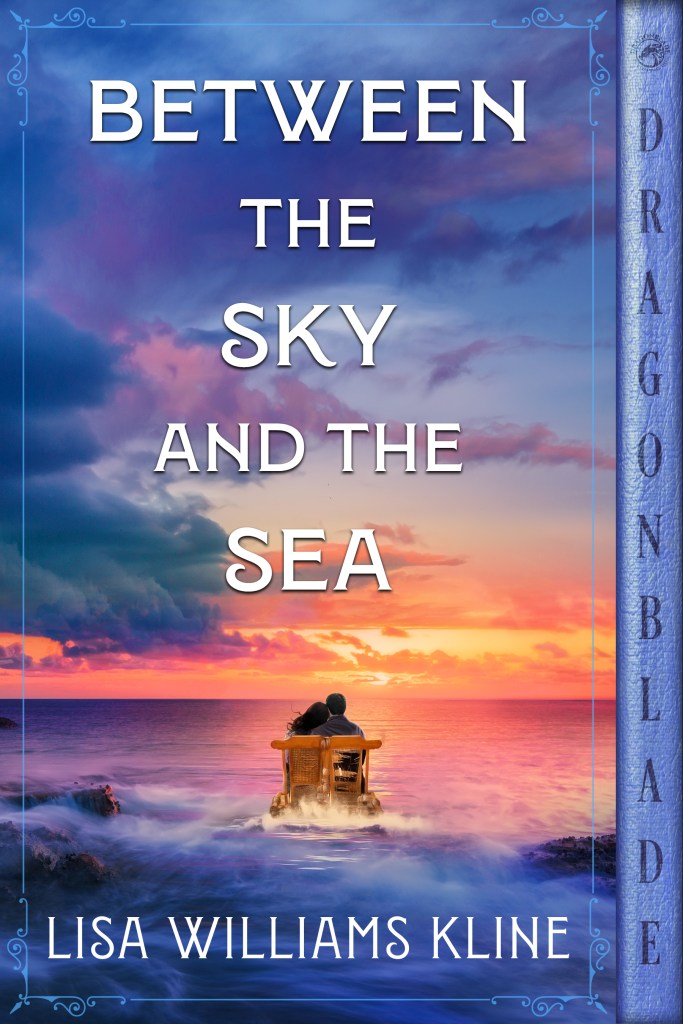
Thank you for saying that about heart and soul! When I wrote my first novel, Eleanor Hill, I intended it as an adult novel, but because my main character was in her teens, it was published as a middle-grade or tween novel. I had many more ideas for books for young readers, so I kept writing them, stealing from my grandmother’s childhood, my own childhood, and my daughters’ childhood. By the time my daughters left for college, though, my ideas for books had begun to be more for adults, and I decided to move in that direction. It felt more natural and I didn’t have young people in my house to remind me every day about what youth was like. Now I’ve written two books for adults, Between the Sky and the Sea, which is historical romance, and Ladies’ Day, which is contemporary women’s fiction. The historical fiction was definitely more work – but all work that I enjoyed. I love trying new things. Every attempt at a new genre can teach you something. I tried writing a short play once – and realized just how much I still could learn about dialogue and drama.
Writing a novel is something so many people say that they will do one day. What prompted you to put pen to paper?
I dreamed of becoming a writer and writing a novel when I was in elementary school. In second grade I wrote and illustrated a series called “The Adventures of Little Horse and Little Lamb.” In fifth grade I wrote the beginning of a novel about a girl and her brother on a barefoot quest through the mountains in the snow to get penicillin for a younger brother who was sick. I never finished this novel – I left my poor characters barefoot in the snow. Maybe I realized they could just go to the pharmacy to get the penicillin. And why didn’t they have boots? Plot problems abounded.
I then gave up on the dream to write a novel for a long time, but when I was in my mid-thirties, my grandmother died, and I inherited all of her photos and letters. I was fascinated by her childhood on the Outer Banks of North Carolina around 1910. I decided at that point to try to write the novel I’d always wanted to write.
We are Dragonblade siblings! How has writing an American historical novel changed your approach to developing characters? (Ie, versus contemporary novels).
What I found when writing Between the Sky and the Sea was that people’s mindsets, morals, and expectations are so different during different time periods. For example, single young women in 1838, when my story takes place, did not normally wander about unescorted. Also, married women in 1838, when my story takes place, generally were not allowed to inherit property. People today might be outraged by these things, but my editor pointed out to me that my characters could be angry and frustrated, yes, but not outraged or surprised because this was what they had grown up with, what they had been used to all their lives. So developing historical characters does take more research and digging to make sure you’re not portraying them inaccurately. You can let your reader be outraged by the things that happened.
So, I think that maybe I am trying to be more careful about all my character development these days, contemporary as well as historical, to make sure I’m not making assumptions or taking attitudes or beliefs for granted.

In your novel Between the Sky and the Sea, the reader is taken onto the waves. What was it like researching naval life in 1838?
I was fascinated by the wreck of the Pulaski when its remains were discovered about thirty miles off the coast of North Carolina in the summer of 2018. I avidly read all of the articles about the dive in the Charlotte Observer, then started doing more independent research on JSTOR, a scholarly online resource. I found an article in the Delaware Gazette from 1838 which described a young man and young woman who had noticed each other on board the ship but not officially met becoming engaged after floating together for four days after the wreck on a raft made of two deck settees. A four-day courtship in peril! I was hooked!
I enthusiastically started writing. Then of course, Covid hit. Going to Savannah to do research wasn’t an option. Besides, the Georgia Historical Society in Savannah was closed, and so was the Ships of the Sea Maritime Museum. There were photos online of the model of the Pulaski that is in the Ships of the Sea Maritime Museum, so I looked at those photos instead of the real model. I spent quite a lot of time online researching architecture, maps of Savannah and New Orleans, clothing, attitudes, the history of Savannah, railroads – the list goes on. I ordered and read a boatload of books. Finally, after Covid eased and even after I had the contract with Dragonblade, I was able to visit Savannah and see the places in person that I had imagined would be where Lavinia’s house and millinery shop were located. All in all, it took me about five years to research and write Between the Sky and the Sea.
Our readers are so important to us. What do you hope your readers take away from your books?
I read an interview with Margaret Atwood, who said, “Brain scientists have told us that an in-depth novel is the closest thing to lived experience that we can encounter. It presents us with whole-human-being characters, and is said to increase empathy. So we are not just looking at the experience from the outside, we are living it from inside the minds of the characters. Not only what the character did, but how the character felt.”
I think that idea is really cool. It made me realize that when I read and also when I write, it’s to help me understand the feelings of others.
Reading a good story is one of the greatest joys of my life. I hope to bring readers joy at having met characters they loved and a sense of satisfaction at having experienced a story well-told. That said, I also keep trying to hone my craft to get better at it.
Thanks so much for these great questions, Emily! It’s been lots of fun to collaborate on interviews. Readers can read my interview with you on my blog at www.lisawilliamskline.com.
Thank you so much for your time, Lisa!
 Emily E K Murdoch